 Skip-the-line available
 Villa del Balbianello on film: Star Wars, Casino Royale and more
Three films were shot at the villa on its point at Lenno; here is what you can see on a visit, and the older story behind the house.
Scenes from Star Wars: Episode II – Attack of the Clones (2002) and Casino Royale (2006) were filmed at Villa del Balbianello, on the Dosso di Lavedo promontory at Lenno on Lake Como. Star Wars used the villa for its lake retreat scenes, and A Month by the Lake (1995) was filmed here too. FAI, which has run the villa since 1988, refers to “the film areas” of the garden. Your ticket includes a guided tour of the interiors and a self-guided visit of the garden, the terraces and the Loggia Durini, so you have time to find those settings at your own pace. This guide sets out the three films, the parts of the estate visitors come to recognise, and the long history that makes the house worth seeing for its own sake.
The three films shot at the villa
Three films are recorded as having been shot at Villa del Balbianello. The earliest is A Month by the Lake, released in 1995. It is the earliest of the three, and it brought the villa to cinema audiences before either of the larger productions that followed.
The second is Star Wars: Episode II – Attack of the Clones, released in 2002. The villa was used for the film’s lake retreat scenes. If you have seen it, the terraces and the loggia may already feel familiar when you arrive.
The third is Casino Royale, released in 2006. Scenes were filmed here too, four years after Star Wars. Between them, the two productions brought the villa, by then in FAI’s care, to a very wide audience.
We keep to the facts here: these films shot scenes at the villa. We do not retell plots or describe particular shots. Watching the films before you go is the best way to arrive knowing what you want to look for.
The film areas of the garden
FAI, which runs the villa, refers to “the film areas” of the garden. They are part of the outdoor half of your visit. After the guided tour of the interiors, the garden, the terraces and the Loggia Durini are yours to explore at your own pace, with no fixed route.
That freedom matters if the films are your reason for coming. You are not hurried past a viewpoint by a group. You can stand where you like, wait for a quieter moment and take the photograph you came for. Leave time for this after the tour, because last park entry and closing come earlier from November.
Visitors most often look for three things: the arched loggia, the terraces over the water, and the sculpted garden between them. The sections below describe each, so you know what you are looking at when you find it.
The garden the cameras used is still kept by FAI as a garden first. The paths, statues and topiary are carefully maintained, so keep to the paths and follow what staff ask of visitors on the day.
The Loggia Durini
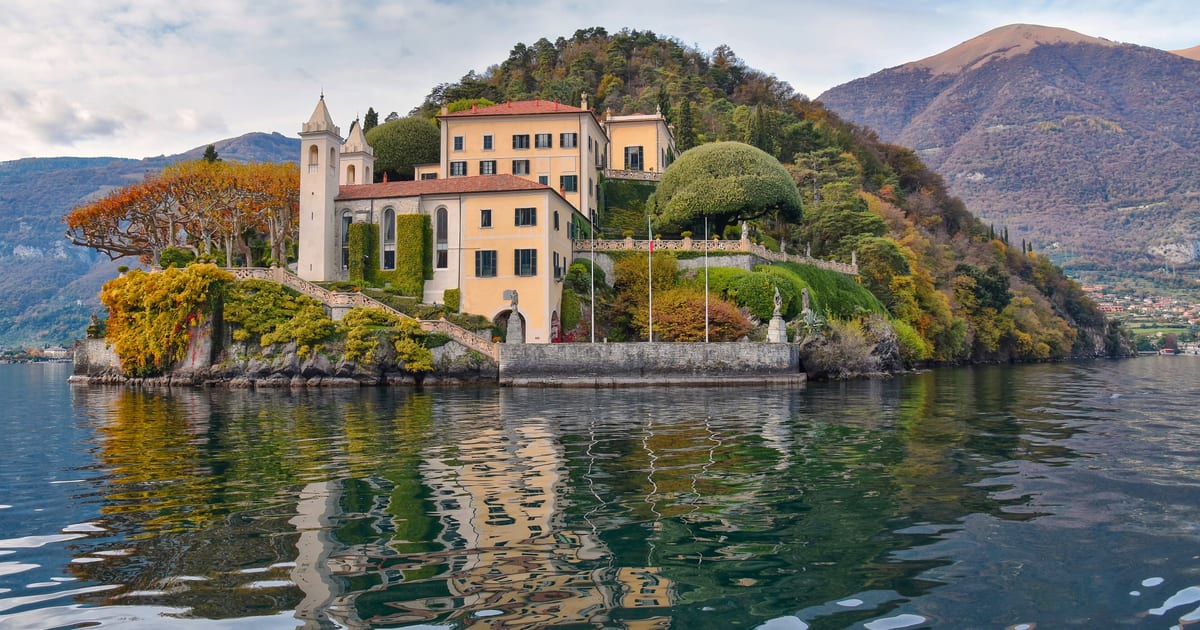
The Loggia Durini is an arched loggia. It is covered in Ficus repens and has a wind rose inlaid in its floor. It was added in the late 18th century, when Cardinal Angelo Maria Durini turned the property into a summer villa, and it was placed to give views of both arms of the lake.
Inside the loggia are the Music Room and the Library. The Library holds the mountaineering and geography books of Count Guido Monzino, the villa’s last private owner. The Music Room and the Library show the villa as a place where its last owner read, planned and kept his books, not only as a backdrop. The loggia is reached by stairs, so anyone with limited mobility should know that before they set out.
If you know the loggia from a screen, take a moment there in person. Look down at the wind rose, then out at the two arms of the lake. It is easy to see why the cardinal built it where he did.
Allow time here on the way round. The loggia holds two rooms and opens onto views of both arms of the lake, so it rewards a slower pace than the paths on either side of it.
The terraces and the topiary
The garden is known for its dramatic topiary. The best-known example is a large holm oak, pruned into the shape of an umbrella. Statue-lined paths connect the parts of the garden and lead out to panoramic terraces over the water.
The terraces are where the lake fills the whole view. It is here that most visitors pause longest, whether or not they have seen the films. Walk the paths slowly, and look back at the house from each terrace; the angles change with every turn.
The garden was improved by Giuseppe Arconati Visconti, who also worked on the loggia. What you see today is the result of more than two centuries of owners shaping a steep, narrow point into a garden, and of FAI’s care since 1988.
Dogs on a lead are welcome in the garden, so a visitor with a dog can enjoy this part of the visit fully. Only guide and assistance dogs may go inside the villa, so plan for someone to wait outside with any other dog during the tour.
Before the cameras: a convent and a cardinal
Long before any film crew arrived, a Franciscan convent stood on the point, from the 13th century. The two towers you see today are what remains of its church. They are the oldest part of the estate and a reminder that the promontory was chosen for retreat long before it was chosen for a set.
In 1785 Cardinal Angelo Maria Durini bought the property. In 1787 he made it a summer villa and added the loggia that now bears his name, with views of both arms of the lake. FAI places the creation of the villa at the end of the 18th century.
The cardinal’s choices still shape the visit. The loggia is a centrepiece of the outdoor visit, and the sense of a house built for looking at the water starts with him.
Look for the two towers as you walk the grounds. They are centuries older than the villa around them, and they make clear that the promontory was a place of retreat long before it became a place of filming.
Patriots, a poet and new owners
After 1796 the villa passed to Luigi Porro Lambertenghi, the cardinal’s nephew. Patriots met at the house. The writer Silvio Pellico tutored Porro Lambertenghi’s sons, and in 1820 Pellico was arrested by the Austrian authorities. One of the streets with parking in Lenno today carries his name.
The property was later sold to Giuseppe Arconati Visconti, who improved the garden and the loggia. FAI lists the Porro Lambertenghi and Arconati Visconti families among the owners, together with Marie Peyrat and the American general Butler Ames, who bought the villa in 1919.
Each owner left a layer. The convent towers, the cardinal’s loggia, the garden shaped by later owners and Monzino’s collections sit side by side. That is why the guided tour is worth taking seriously, even if you came for the films.
If you park on Via Silvio Pellico in Lenno and walk up to the villa, you are already following one thread of this story. It is a small link, but it shows how closely the house’s history is tied to the village below it.
Guido Monzino, explorer
In 1974 the villa was bought by Count Guido Monzino, who lived from 1928 to 1988. He was an explorer. He led the first Italian expedition to climb Everest, in 1973, and in 1971 he made a sledge expedition from Cape Columbia to the North Pole.
His collections fill the house. The rooms hold 18th-century French furniture, non-European art, silver, ceramics, painted glass and Beauvais tapestries. In the attic, the Museum of Expeditions holds the largest collection of Inuit ivories outside Greenland, and the sledge from the 1971 North Pole expedition. His collections of maps and books are part of the house too.
When Monzino died in 1988, he left the villa, most of the promontory and an endowment to FAI. FAI has run it ever since. The house you visit is, in large part, his: an explorer’s home, filled with the objects of a life spent travelling to the ends of the earth.
The guided tour is the way to see these collections. It lasts about 50 minutes, runs in Italian or English and takes groups of no more than 16, which keeps the rooms calm enough to look properly at the ivories, the sledge and the books.
Seeing the villa from the water
The promontory is easiest to understand from the lake. The public boats of Navigazione Laghi run a central-lake itinerary linking Varenna, Bellagio and Lenno, and arriving that way gives you a look at the point before you land.
From Lenno, the villa is reached on foot: about 1 km, uphill and partly on gravel, in around 25 minutes. A taxi boat from the Lido di Lenno is the alternative. It is paid, it is not run by FAI and it works by reservation only. We do not sell or arrange it.
Seeing the point from a boat first, then walking its terraces, gives you both perspectives on the setting the film crews came for. It is worth the small effort of planning, and it turns the arrival into part of the visit.
Ferry timetables vary by season, so check the current one before you choose your entry time. Then work backwards: the walk of about 25 minutes, a margin for the unexpected, and arrival at the ticket office no more than 30 minutes before your slot.
Planning a visit around the film settings
Your ticket covers a guided tour of the interiors, about 50 minutes, in Italian or English, in groups of no more than 16. It also covers the self-guided visit of the garden, the terraces and the Loggia Durini, where the film settings are. The time you book is your garden entry time; your tour time is assigned when the ticket is validated, with a maximum wait of 60 minutes.
Tickets are sold online only and booking is mandatory. The guided tours fill days ahead, even in late October. We are an independent booking service, not FAI: you choose your date and entry time, pay one total, and we book your tickets on the official system and email your e-ticket to you. The fares cover adults aged 19 and over, ages 6–18, students aged 19–25, and families of two adults with two or more of their children aged 6–18. Children aged 0–5 go free and are added to the booking at no charge.
Paid photo shoots at the villa are only by arrangement with FAI and are not part of a visitor ticket. For personal photographs in the garden, simply take your time. Inside the villa, photography rules are not published, so ask your guide.
Arrive at the ticket office no more than 30 minutes before your entry time; late arrivals are not guaranteed entry. Our getting there guide covers the walk from Lenno, taxi boats and parking, and our tickets guide covers the fares and the rules on site.
Frequently asked
Was Star Wars filmed at Villa del Balbianello?
Yes. Star Wars: Episode II – Attack of the Clones (2002) used the villa for its lake retreat scenes. The garden, the terraces and the Loggia Durini are part of the self-guided half of a visit.
Which other films were shot at the villa?
Casino Royale (2006) filmed scenes at Villa del Balbianello, and so did A Month by the Lake (1995). Together with Star Wars: Episode II, that makes three recorded film productions.
Can visitors see the film locations?
Yes. FAI refers to “the film areas” of the garden. After the guided villa tour, you explore the garden, the terraces and the Loggia Durini at your own pace, with no fixed route.
Do I need to book in advance to see the film settings?
Yes. Tickets are sold online only and booking is mandatory. The guided tours fill days ahead, even in late October, so book your date and entry time before you travel.
Can I do a professional photo shoot at the villa?
Only by arrangement with FAI. Paid photo shoots are not part of a visitor ticket. Personal photographs in the garden are part of a normal visit; inside the villa, ask your guide.
Is there more to the villa than the films?
Much more. The towers survive from a 13th-century Franciscan convent, the loggia dates from 1787, and the rooms hold explorer Guido Monzino’s collections, including the largest collection of Inuit ivories outside Greenland.